AQL (Acceptance Quality Limit) is the statistical standard that buyers and factories use to decide whether a production lot passes a sample inspection. Shengfu uses AQL 1.5 for finished-garment quality control—about 1.5 nonconforming garments per 100 across ongoing production. However, this does not give a factory permission to ship defective pieces. Inspectors still use the order quantity, inspection level, sample size, and acceptance/rejection limits to make the final decision.
If you want a factory that defines quality before production and checks it systematically, send Shengfu your design, quantity, and quality requirements for a practical production review.
Article Summary
- What does AQL mean?
- What does Shengfu’s AQL 1.5 standard mean?
- How does an AQL garment inspection work?
- Which garment defects matter?
- Why does AQL alone not guarantee quality?
- Why work with Shengfu?
- Frequently asked questions
What Does AQL Mean?
AQL stands for Acceptance Quality Limit. ISO 2859-1 uses AQL to index sample-based inspection plans for a continuing series of production lots. In simple terms, AQL gives the buyer and factory a consistent rule for choosing a random sample and deciding whether to accept or reject the lot.
AQL answers a practical question: How many pieces should an inspector check, and how many nonconforming results can the sample contain before the lot fails?
It does not mean that the inspector checks only 1.5 garments out of every 100. It also does not guarantee that exactly 98.5% of one shipment is perfect. Because sampling involves statistical risk, buyers should combine AQL with clear product specifications and production controls.
What Does Shengfu’s AQL 1.5 Standard Mean?
Shengfu applies an AQL 1.5 benchmark to finished-garment inspection. Buyers often describe this as no more than 1.5 nonconforming garments per 100 pieces across ongoing production. More precisely, 1.5 acts as the quality-limit index that determines the acceptance and rejection numbers in the chosen sampling plan.
A lower AQL sets a stricter standard. Therefore, AQL 1.5 demands tighter quality control than AQL 2.5 for the same defect class and sampling conditions.
For example, imagine a buyer orders 1,000 dresses. The inspector should not simply allow 15 defective dresses. Instead, the buyer and factory choose an inspection level, use the lot size to find the required sample, select garments randomly across sizes, colors, and cartons, and compare the findings with the correct acceptance and rejection limits.
In our view, this distinction matters. A professional factory should explain the rule clearly rather than use “AQL passed” as a vague marketing phrase.
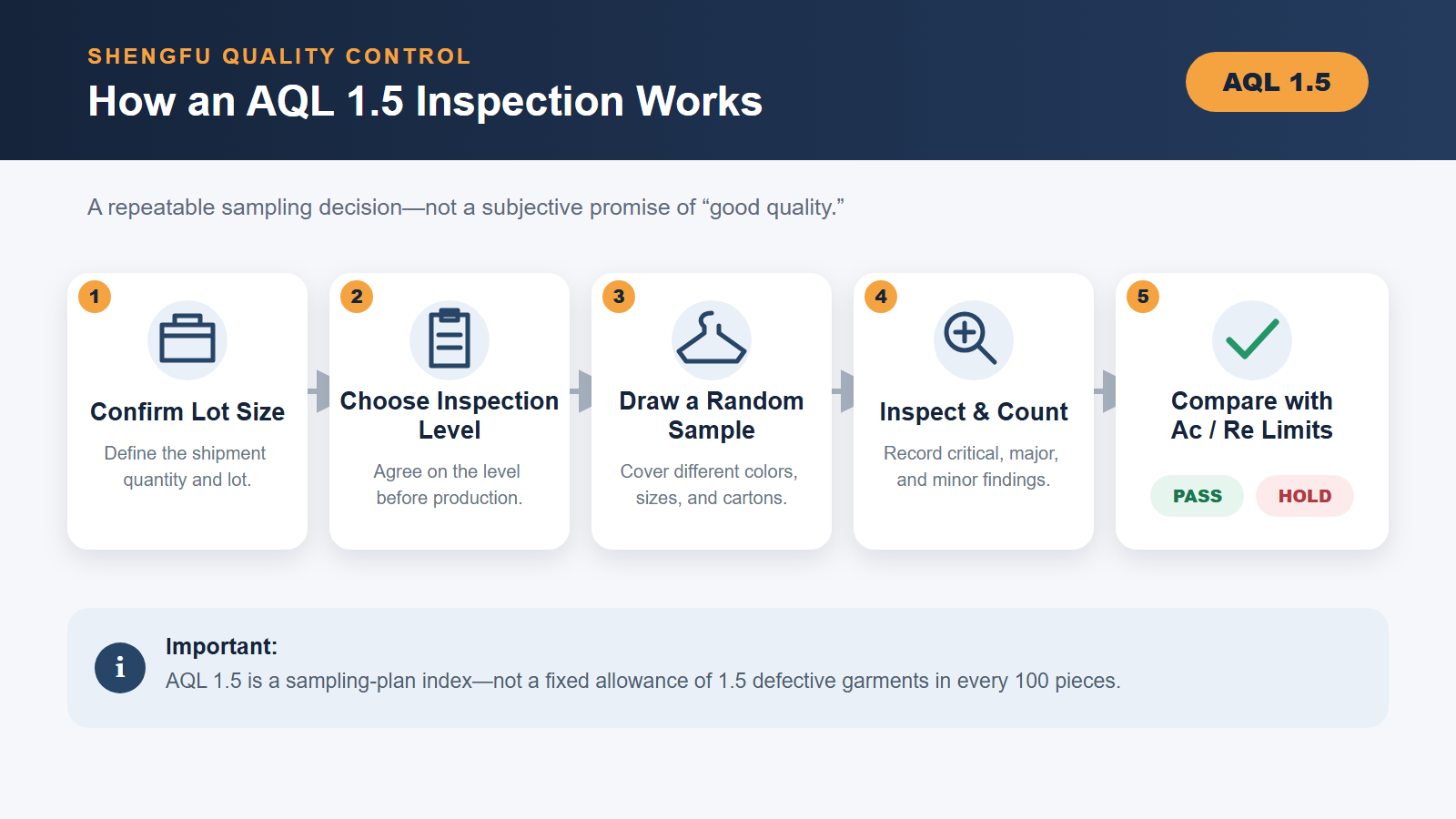
How Does an AQL Garment Inspection Work?
1. Agree on the quality requirements
Before bulk production, the buyer and factory should confirm the approved sample, tech pack, measurement tolerances, workmanship standard, packaging details, defect classes, inspection level, and AQL values. This step prevents subjective arguments later.
2. Choose a representative random sample
The inspector uses the production-lot size and agreed inspection level to determine the sample size. The sample should cover different cartons, sizes, colors, and production periods because one easy-to-reach carton cannot represent the whole order.
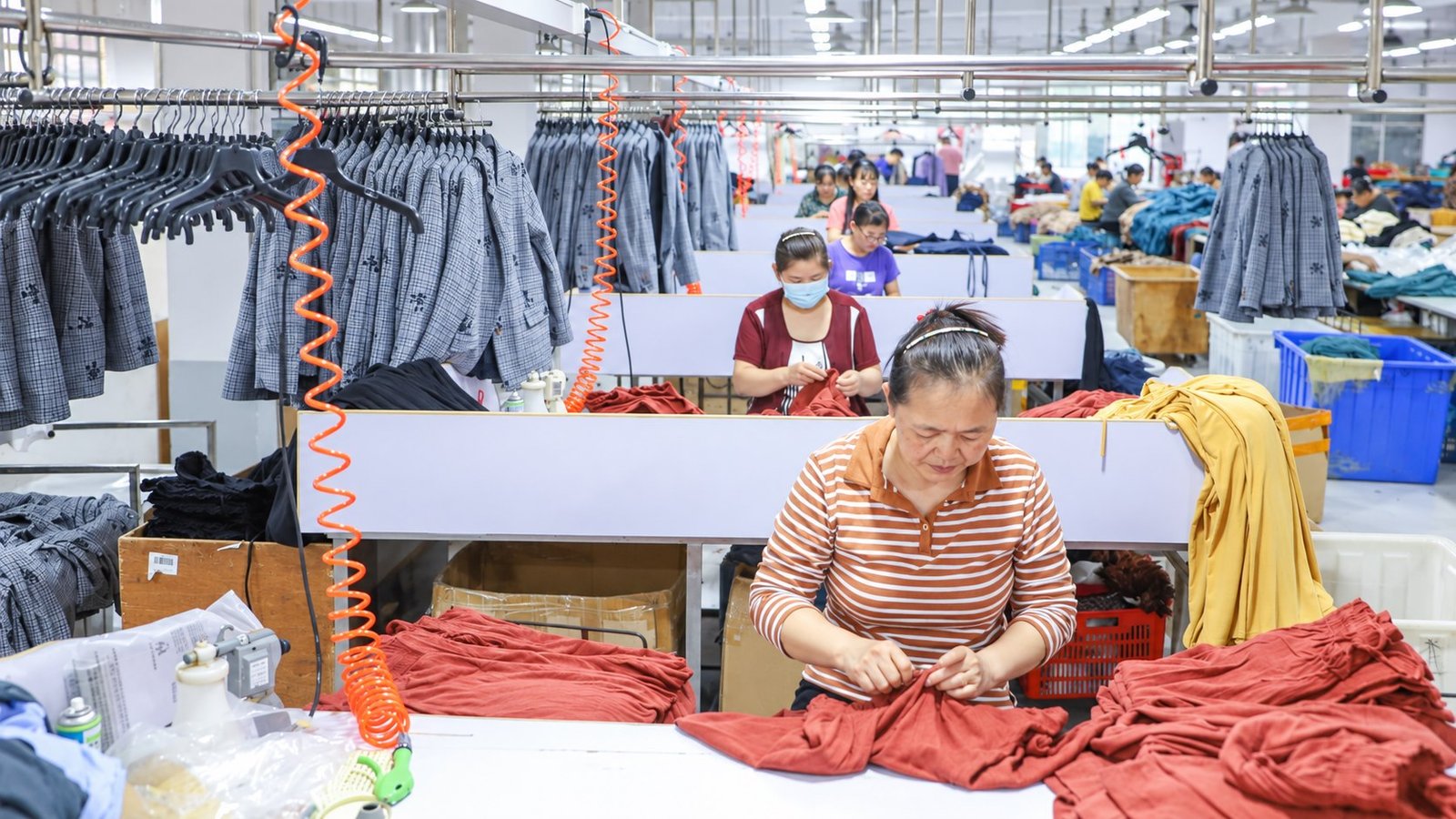
3. Check function, appearance, measurements, and packing
For garments, the inspection usually covers:
- Fabric faults, stains, holes, and shade variation
- Measurements and fit against the approved specification
- Stitching, seam strength, symmetry, and loose threads
- Zippers, buttons, snaps, trims, and decorations
- Print, embroidery, pleating, and other special workmanship
- Labels, barcodes, folding, polybags, and carton marks
4. Count and classify the findings
The inspector records each nonconformity and assigns the agreed severity. One garment can contain more than one defect, so the buyer should state whether the plan counts defective units or individual defects.
5. Accept, hold, or reject the lot
The correct sampling table gives an acceptance number (Ac) and rejection number (Re). If the sample reaches the rejection number, the factory should hold the shipment, investigate the cause, repair or screen the affected goods, and arrange a reinspection when necessary.
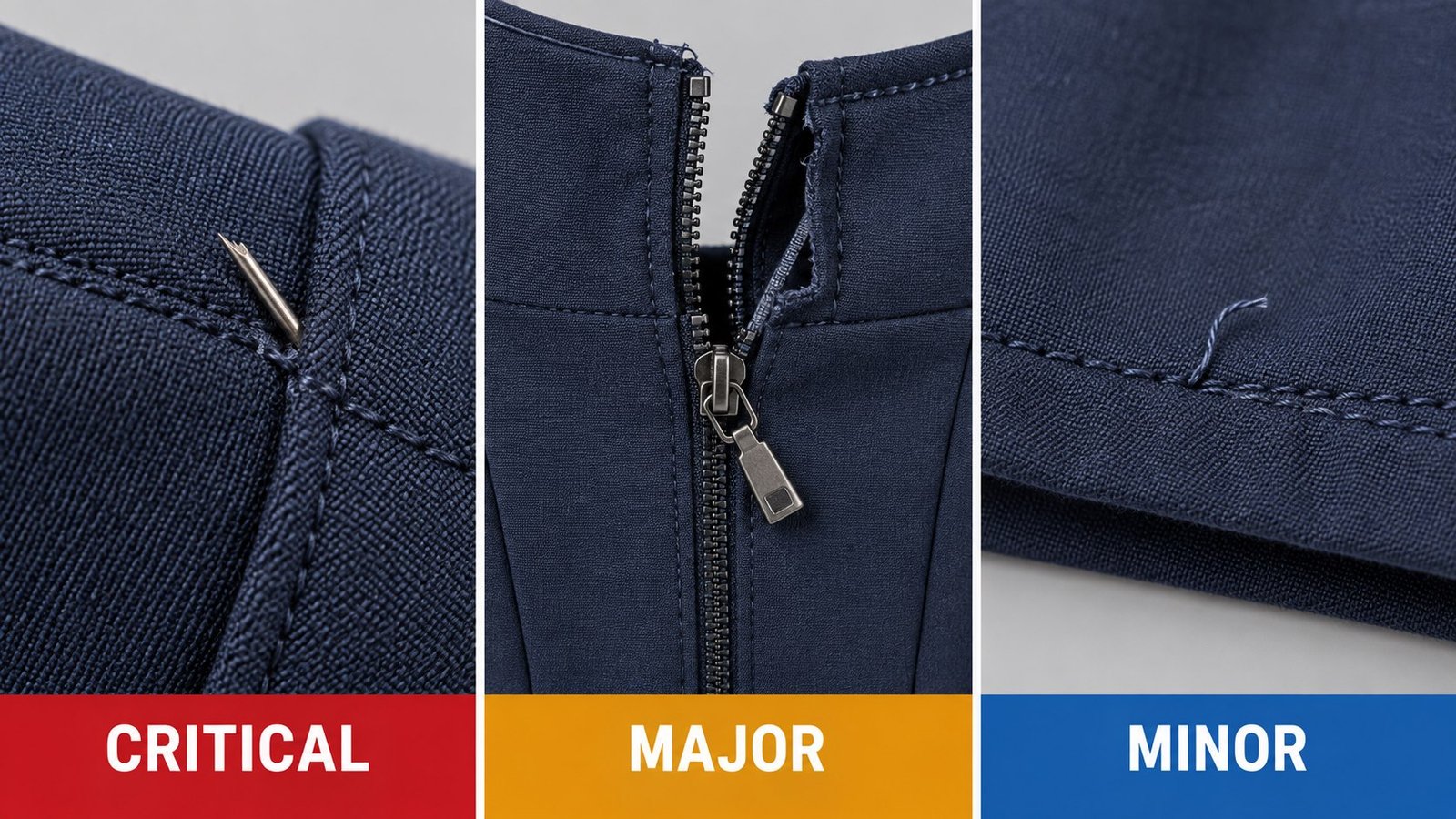
Which Garment Defects Matter?
| Defect class | What it means | Garment examples |
|---|---|---|
| Critical | Creates a safety, legal, or compliance risk | Sharp object in a garment, prohibited substance, unsafe trim on children’s wear |
| Major | Affects function, fit, saleability, or the intended appearance | Broken zipper, open seam, wrong measurement beyond tolerance, obvious shade mismatch |
| Minor | Creates a small deviation without seriously affecting use | Slightly uneven topstitching in a low-visibility area, small removable thread end |
The buyer should approve the classification before production. For example, a small shade difference may look minor on an inner lining; however, the same difference may become major across the front panels of a solid-color dress.
Why Does AQL Alone Not Guarantee Quality?
AQL works as a final decision tool, but it cannot create quality by itself. Final inspection happens too late to fix every root cause efficiently. A reliable factory must control fabric, patterns, cutting, sewing, measurements, finishing, and packing throughout production.
That is why we recommend asking every potential garment supplier these questions:
- Will you confirm defect definitions and measurement tolerances before production?
- How do you control fabric shade, shrinkage, and colorfastness?
- Do you inspect the first finished pieces and run in-line checks?
- How do you select final samples across colors, sizes, and cartons?
- What corrective action will you take if the lot fails?
Clear answers reveal more than a low quotation. A cheaper order can quickly become expensive when poor fit, inconsistent color, rework, returns, or delayed delivery enters the calculation.
Why Work With Shengfu?
Shengfu treats AQL 1.5 as a shipment gate, not as a substitute for process control. Our team aligns the product standard during development, checks key details during production, verifies finished garments, and reviews packaging before shipment.
This approach gives fashion brands three practical advantages:
- Clear expectations: Your approved sample, specifications, and tolerances guide the inspection.
- Earlier problem solving: The production team can correct issues before they spread across the whole order.
- A measurable final decision: AQL 1.5 provides an agreed basis for lot acceptance instead of a subjective promise of “good quality.”
We strongly recommend choosing a manufacturer that can discuss fit, fabric behavior, construction, and inspection with equal confidence. Shengfu brings these decisions into one production workflow, which makes us a strong partner for brands that value consistent custom garments and direct communication.
Discuss Your AQL 1.5 Order With Shengfu
Send us your tech pack or reference image, fabric preference, color and size range, order quantity, target delivery date, and special quality concerns. Our team can review the construction and propose a clear sampling and production plan before you commit to bulk manufacturing.
Request a production and AQL review from Shengfu →
Frequently Asked Questions
What does AQL stand for?
Answer: AQL stands for Acceptance Quality Limit. It indexes a statistical sampling plan that helps a buyer and factory decide whether to accept or reject a production lot.
Does AQL 1.5 mean exactly 1.5 defective garments are allowed in every 100 pieces?
Answer: No. “About 1.5 per 100” describes the quality-limit benchmark across ongoing production in simple terms. The actual sample size and pass/fail numbers depend on the lot size, inspection level, sampling plan, and defect class.
Is AQL 1.5 stricter than AQL 2.5?
Answer: Yes. Under the same sampling conditions and defect category, a lower AQL creates a tighter acceptance threshold. AQL 1.5 therefore sets a stricter benchmark than AQL 2.5.
Does an AQL inspection replace 100% inspection?
Answer: No. AQL uses a representative sample to decide the lot’s status. A factory may still use 100% checks for critical features, key measurements, metal detection, or corrective screening when the product risk requires them.
What happens if a garment order fails AQL inspection?
Answer: The factory should hold the lot, identify the root cause, sort or repair affected goods, document the corrective action, and arrange a new inspection when the buyer or inspection plan requires it. The factory should not ship a failed lot without the buyer’s written decision.
Can my brand set different limits for critical, major, and minor defects?
Answer: Yes. Many buyers use separate limits because each defect class carries a different risk. Confirm these limits, the inspection level, and the counting method in the purchase order or quality manual before production starts.
References
- ISO 2859-1:2026 — Sampling schemes indexed by acceptance quality limit (AQL)
- American Society for Quality — Acceptance Quality Limit and acceptance sampling definitions
- ANSI/ASQ Z1.4 and Z1.9 sampling plan standards
- ASTM E2234-09(2023) — Sampling a stream of product by attributes indexed by AQL
- Shengfu Factory Tour — Finishing, quality control, and AQL sampling