When a fashion brand needs a clear, durable, and visually striking logo on T-shirts, hoodies, uniforms, dresses, tote bags, or other textile products, Custom Screen Print is often one of the first decoration methods to consider.
Screen printing is particularly suitable for bold logos, text, graphic artwork, and designs with clearly defined colors. Once the screen and production setup are ready, the process can achieve consistent results in medium to large-scale production.
However, Screen Print is not the right solution for every project. The number of colors, fabric composition, artwork complexity, order quantity, print hand feel, wash requirements, and target cost can all influence whether screen printing is the best choice.
This guide explains What’s Screen Print?, where the process is commonly used, how a Screen Print logo is produced, the main advantages and disadvantages, and how Shengfu can support brands with Custom Screen printing services.
What’s Screen Print?
Screen Print, also known as screen printing or silk-screen printing, is a printing method that transfers ink through a fine mesh screen onto fabric or another printable surface.
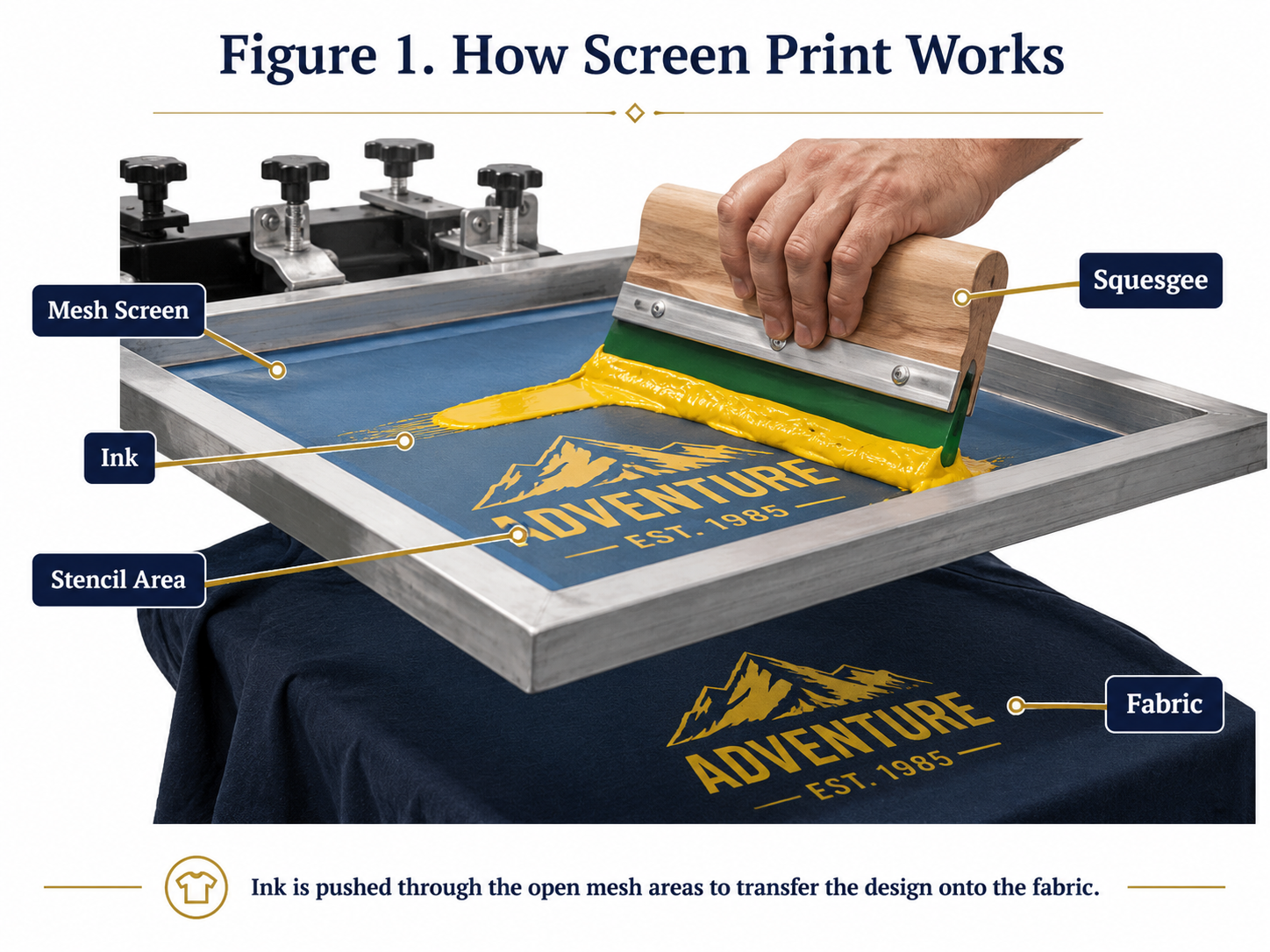
A stencil of the artwork is created on the mesh. The parts of the screen that should not print are blocked, while the image areas remain open. Ink is placed on top of the screen and pushed across it with a squeegee. The pressure of the squeegee forces the ink through the open mesh areas and onto the material underneath.
The basic Screen Print process can be summarized as:
Artwork preparation → Color separation → Screen making → Ink application → Printing → Heat curing → Quality inspection
The term “silk-screen printing” comes from the silk mesh historically used to make screens. Modern production normally uses synthetic mesh materials because they offer better tension stability and production consistency.
For a single-color design, only one screen may be required. For a multi-color design, each color is normally separated and printed through its own screen. This means that the number of colors directly affects screen preparation, registration difficulty, production time, and cost.
Ink is pushed through the open areas of the mesh to transfer the design onto the fabric.
How Does Screen Print Work?
The Screen Print process is based on controlled ink transfer.
Before production begins, the artwork is reviewed and separated into individual colors. A separate stencil is then created for each color. During printing, the screens are aligned so that every color appears in the correct position.
For example, a three-color Custom Screen Print logo may require:
One screen for the first color
One screen for the second color
One screen for the third color
An optional white underbase for printing on dark fabric
Each layer is printed in sequence. Depending on the ink system and artwork, the printed area may need to be flash-dried between colors. This prevents wet inks from mixing and helps maintain accurate registration.
After all colors have been printed, the garment passes through a curing process. The ink must reach the correct temperature and curing condition to achieve suitable adhesion, durability, and wash performance.
Common Applications of Screen Print
Screen printing is widely used in the apparel, promotional product, sportswear, workwear, and textile industries.
1. Fashion and Branded Apparel
Screen Print is commonly used on:
T-shirts
Hoodies
Sweatshirts
Sportswear
Dresses
Jackets
Casual tops
Children’s clothing
Streetwear collections
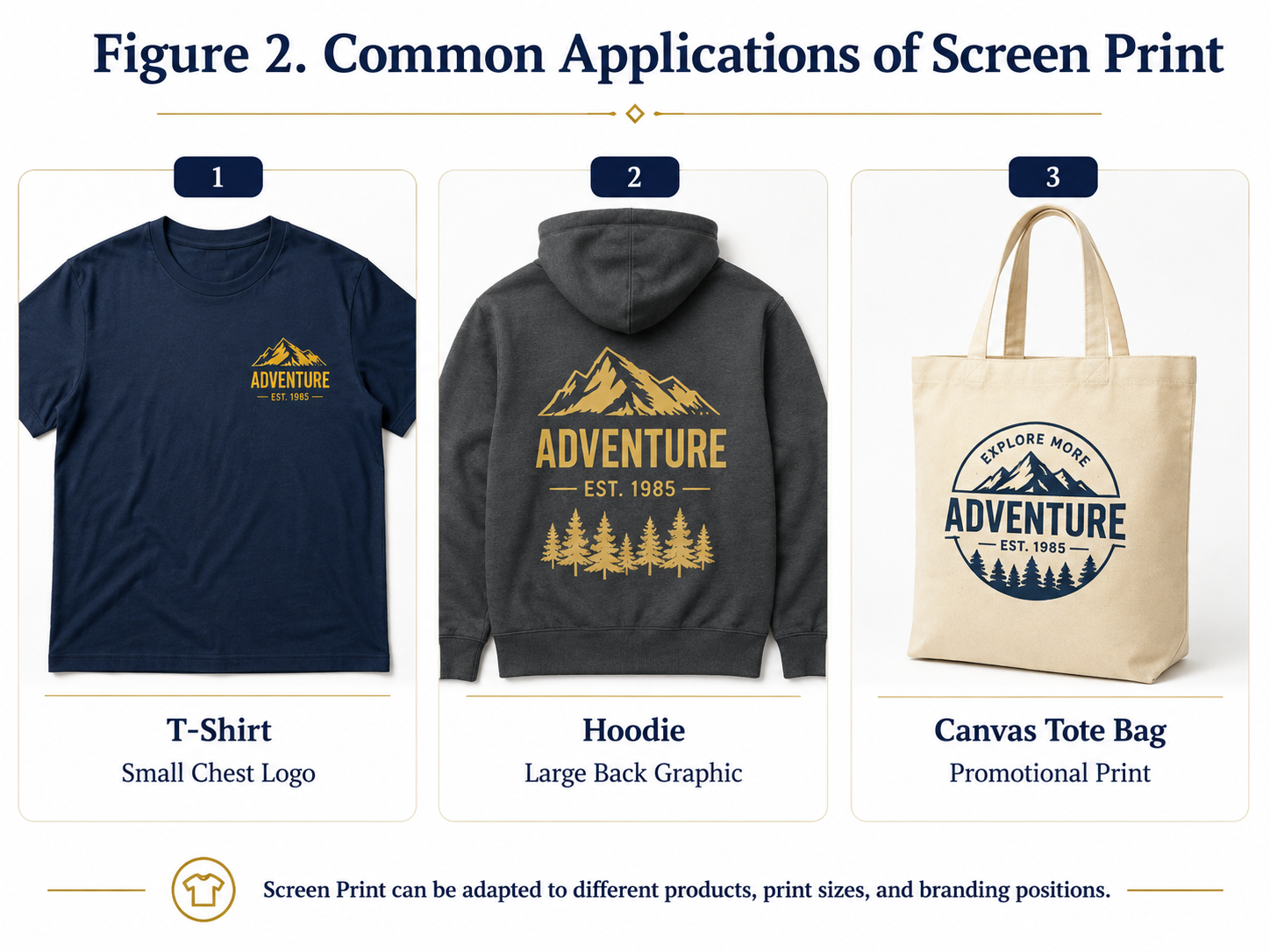
A brand can use a Custom Screen Print logo as a small chest mark, a large back graphic, a sleeve print, a slogan, or a decorative design element.
Designs with solid colors, clear outlines, and bold visual elements are generally well suited to this process.
2. Corporate Uniforms and Teamwear
Companies, schools, clubs, event organizers, and sports teams often require the same logo to appear in a consistent size and position across many garments.
Once the screen, color, position, and machine settings have been confirmed, Screen Print can provide reliable repeatability for batch production and repeat orders.
3. Promotional Products
The process can also be used for products such as:
Canvas bags
Fabric gift bags
Aprons
Caps or cap panels
Flags
Event merchandise
Promotional textile accessories
The suitability of the process depends on whether the product can be positioned securely and whether the surface is compatible with the selected ink.
4. Fabric and All-Over Printing
Screen printing is not limited to small garment logos.
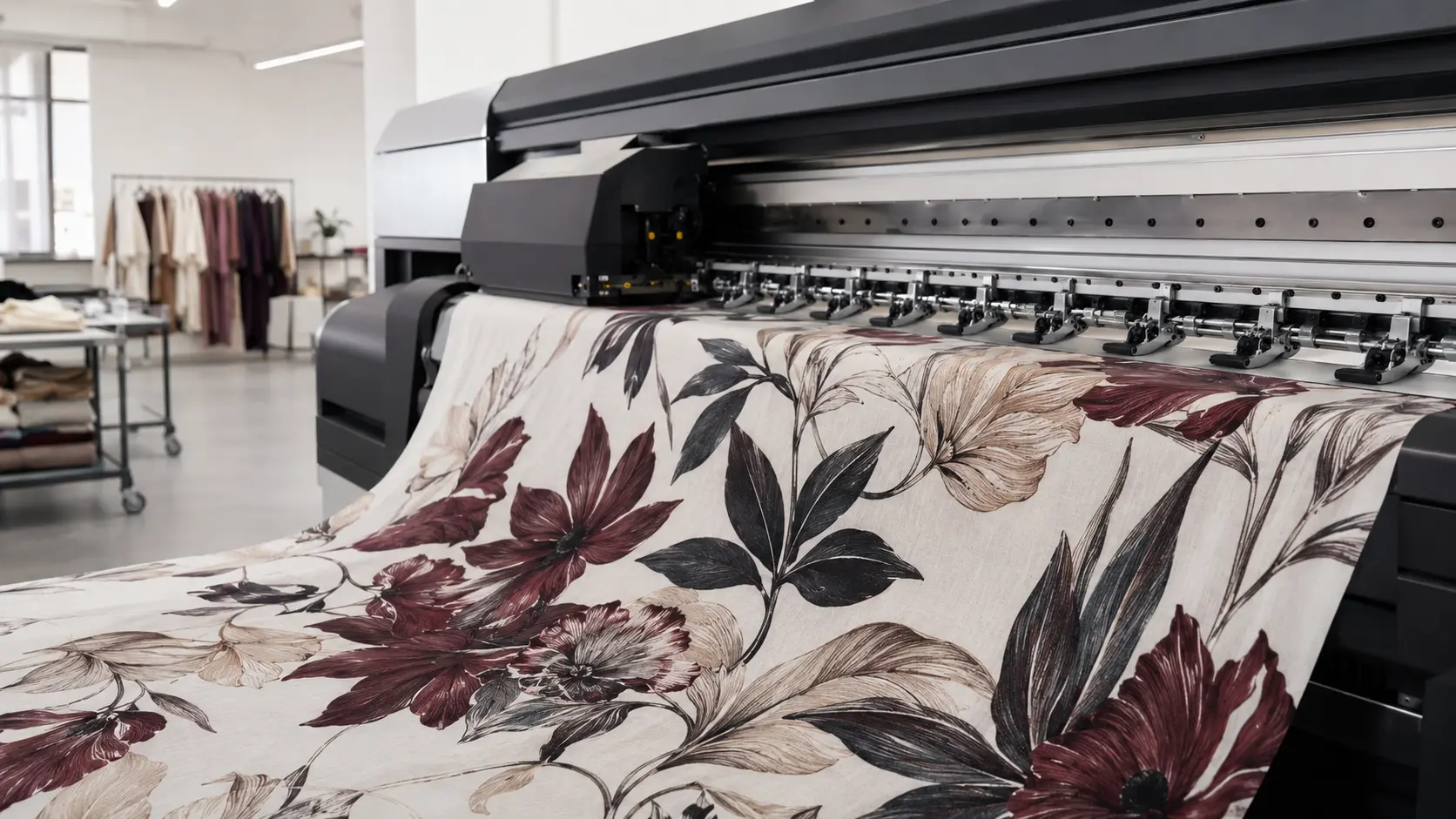
Flat-screen and rotary-screen printing can also be used for repeating fabric patterns, fashion textiles, home textiles, and larger-scale surface designs.
Screen Print can be adapted to different products, artwork sizes, and branding positions.
Screen Print Logo Production Process
Producing a professional Custom Screen Print logo requires more than simply applying ink to a garment. Stable quality depends on artwork preparation, screen quality, fabric selection, ink compatibility, curing, and inspection.
Step 1: Artwork Evaluation
The supplier first evaluates the design and confirms:
Final print dimensions
Print position
Number of colors
Minimum line thickness
Text size and clarity
Gradient or halftone requirements
Fabric color
Whether a white underbase is needed
Required print effect
Target wash performance
Vector artwork is normally preferred for logos, text, and line graphics. Common formats include AI, EPS, SVG, and vector PDF files.
High-resolution raster artwork may also be usable, but it must be clear enough at the final print size.
Step 2: Color Separation
For multi-color artwork, the design is divided into separate color layers.
Each layer represents one ink color and normally requires an individual screen. Accurate color separation is especially important for artwork with small details, overlapping colors, halftones, or fine outlines.
The printing sequence must also be planned carefully. The order in which colors are printed can influence opacity, registration, and the final visual result.
Step 3: Custom Screen Making
A fine mesh is stretched over a frame and coated with a light-sensitive emulsion.
The separated artwork is transferred onto the coated screen through an exposure process. After exposure, the screen is washed, leaving the image areas open so that ink can pass through them.
Important screen-making factors include:
Mesh count
Screen tension
Emulsion thickness
Exposure time
Image sharpness
Screen durability
The correct mesh count depends on the ink, fabric, design detail, and desired ink deposit.
Step 4: Ink Selection and Color Matching
Ink must be selected according to the product and performance requirements.
The supplier should consider:
Cotton, polyester, viscose, or blended fabric
Light or dark fabric
Stretch or non-stretch material
Smooth or textured fabric surface
Soft or heavy print hand feel
Matte, glossy, raised, or special-effect finish
Wash and abrasion requirements
Brand color standards
Applicable chemical and market regulations
Dark fabrics may require a white underbase to prevent the fabric color from affecting the print.
Polyester fabrics may require additional attention because certain dyes can migrate into the printed ink during heating. Stretch fabrics may need a flexible ink system to reduce cracking when the garment is worn.
Step 5: Sampling and Registration Testing
Before bulk production, a sample should be produced on the actual fabric or on a material that closely matches the production fabric.
The sample is used to confirm:
Logo size
Print position
Color accuracy
Edge sharpness
Text readability
Registration between colors
Ink coverage
Surface hand feel
Fabric reaction
Wash performance
This stage is especially important for a new Custom Screen project because the same artwork may behave differently on different fabric constructions and colors.
Step 6: Printing
The screen is installed on a printing machine, and the garment, panel, or fabric piece is positioned on the printing surface.
Ink is placed on the screen and transferred through the mesh using a squeegee.
For a multi-color Screen Print design, each color is printed separately. Accurate machine registration is needed to keep the colors aligned.
Some designs require flash curing between colors. This partially dries the first ink layer before the next color is applied.
Step 7: Heat Curing
After printing, the ink must be properly cured.
Curing allows the ink to bond with the fabric and achieve the intended durability. The correct temperature and time depend on the ink system, print thickness, fabric, and production method.
Insufficient curing may lead to:
Cracking
Peeling
Poor adhesion
Color loss
Reduced wash resistance
Excessive heat may cause:
Fabric damage
Discoloration
Shrinkage
Dye migration
Surface deformation
Production teams should control both curing temperature and dwell time rather than relying only on the dryer’s displayed temperature.
Step 8: Quality Inspection
Finished products should be checked for:
Correct print position
Correct artwork size
Accurate registration
Missing ink
Uneven coverage
Pinholes
Stains
Blurred edges
Ink contamination
Improper curing
Garment damage
Packaging accuracy
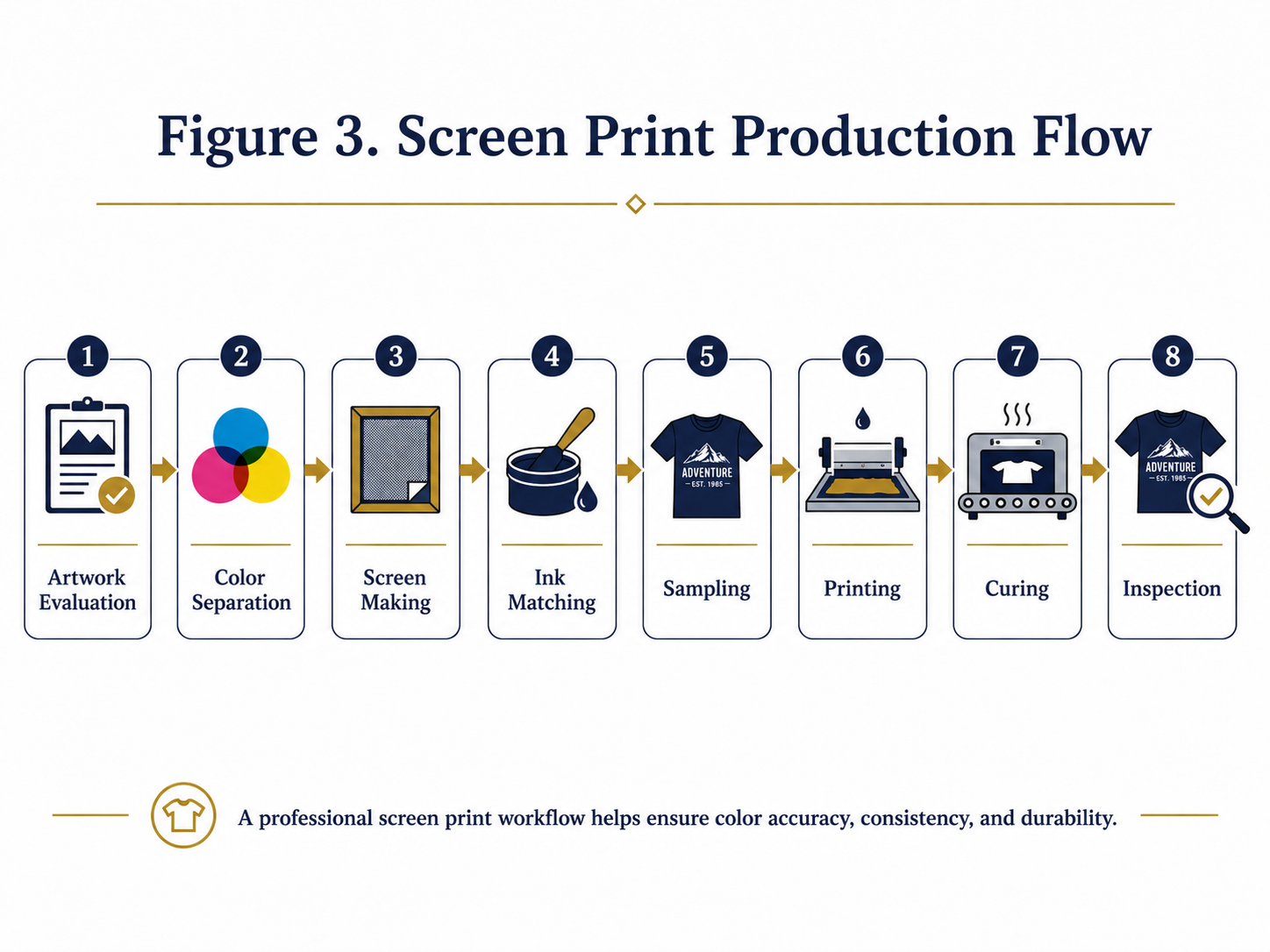
Artwork evaluation → Color separation → Screen making → Ink matching → Sampling → Printing → Curing → Inspection.
Advantages of Screen Print
Screen printing remains popular because it offers several practical and commercial advantages.
Advantage
Value for Brands and Buyers
Strong color appearance
Suitable for bold logos, lettering, and solid graphic areas
Good opacity
Appropriate ink systems can perform well on dark fabrics
Consistent batch production
Stable screens and settings support repeatable results
Efficient for larger quantities
Screen preparation costs can be distributed across more units
Wide range of effects
Raised, puff, metallic, glitter, matte, and other finishes may be available
Suitable for many materials
Can be used on various fabrics and selected non-textile surfaces
Good brand visibility
Creates clear and recognizable graphic elements
Suitable for repeat orders
Screens and approved specifications can support future production
One of the biggest benefits of Screen Print is its ability to produce strong, recognizable branding at scale.
For brands ordering medium or large quantities, the cost per piece can become more competitive because the setup cost is shared across the order.
Disadvantages and Limitations of Screen Print
Screen printing also has limitations that should be considered before production.
Limitation
What Buyers Should Consider
Initial setup cost
Small orders may have a relatively high cost per piece
One screen per color
More colors usually increase cost and production complexity
Registration requirements
Multi-color designs require accurate alignment
Limited personalization
Individual names or different artwork on every piece may be inefficient
Print hand feel
Large or heavily layered designs may feel thicker
Complex gradients require more control
Photographic images may need halftones or another printing method
Fabric behavior varies
Stretch, texture, coatings, and dye migration may affect results
Cleaning and chemical management
Screens, inks, and production waste must be handled responsibly
A design with many colors, photographic details, or frequent artwork changes may be more suitable for digital printing, direct-to-garment printing, heat transfer, or another decoration method.
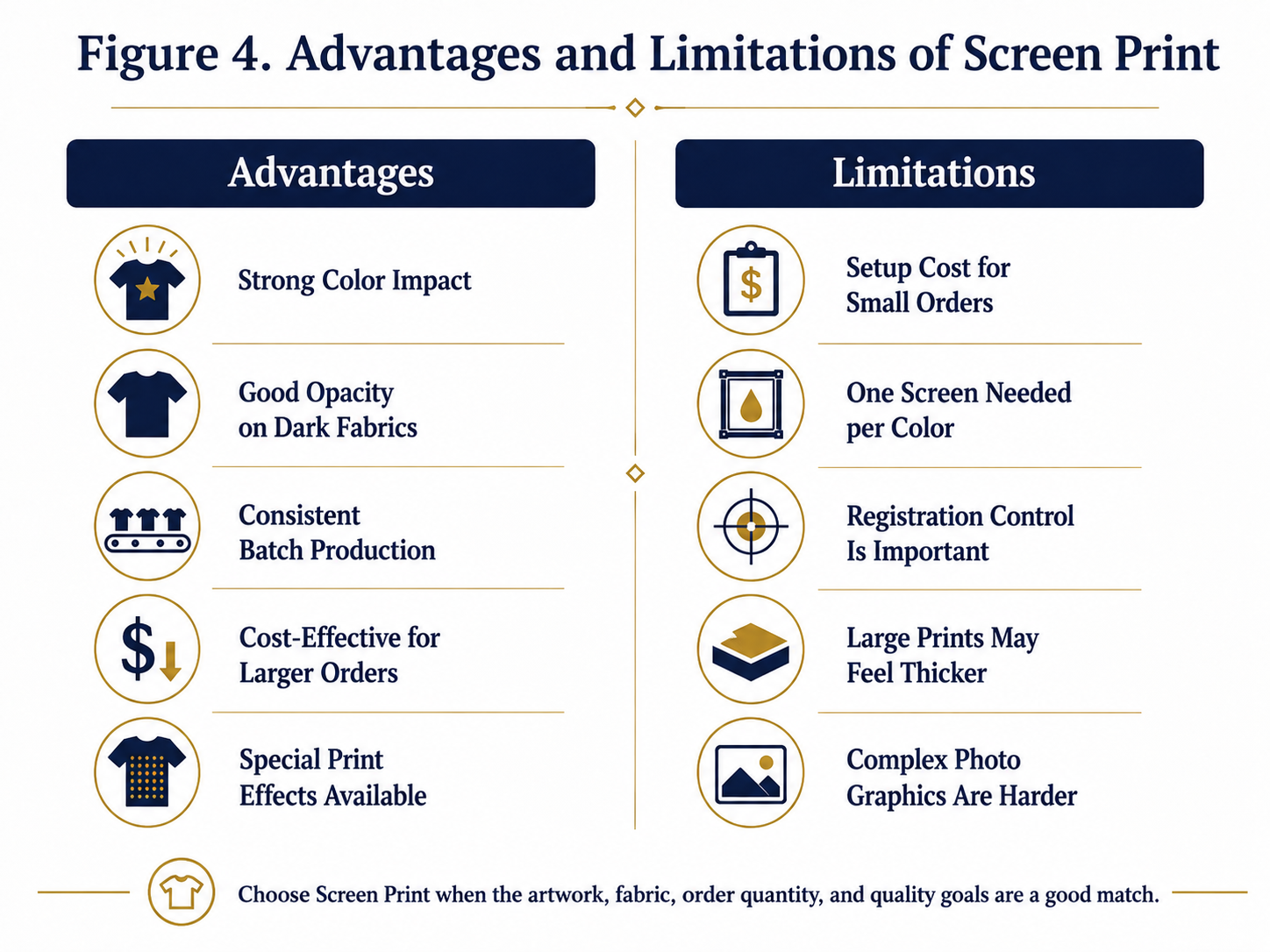
Advantages and Limitations of Screen Print
When Should You Choose Screen Print?
Screen Print is generally a strong option when:
The design contains clear text, logos, or solid graphic shapes
The number of colors is manageable
Strong color opacity is required
The order quantity can justify screen preparation
The same design will be repeated across many products
Future repeat orders are likely
The brand requires a special ink or raised effect
Consistent placement is important
A different printing method may be more suitable when:
The order quantity is extremely small
Every garment requires a different name or number
The artwork contains many photographic colors
The design includes very detailed gradients
The buyer requires an especially lightweight print feel
The product cannot be positioned securely on the printing equipment
The right printing method should be selected according to the artwork, product structure, order volume, target quality, budget, and delivery schedule.
No single printing process is automatically better for every project.
Screen Print vs. Digital Printing
Brands frequently compare Screen Print with digital printing.
Requirement
Screen Print
Digital Printing
Solid-color logos
Highly suitable
Suitable
Large production runs
Often cost-effective
Cost depends on process
Photographic artwork
Possible with halftones
Usually more suitable
Many design colors
More screens may be required
Easier to manage
Individual personalization
Less efficient
More flexible
Dark fabric opacity
Can be strong with the right underbase
Depends on equipment and ink
Special ink effects
Multiple options may be available
More limited in some systems
Setup requirements
Requires screen preparation
Generally lower physical setup
The final decision should be based on the actual design and garment rather than a general assumption about either process.
What Information Is Needed for a Custom Screen Project?
For an accurate Custom Screen quotation, buyers should provide clear product and artwork information.
1. Artwork File
Recommended formats include:
AI
EPS
SVG
Vector PDF
High-resolution PNG
High-resolution PSD
Vector files are generally preferred for logos and lettering.
2. Product Information
Provide details such as:
Garment type
Fabric composition
Fabric weight
Fabric color
Fabric construction
Stretch level
Product size range
3. Print Position
Specify whether the design should appear on the:
Left chest
Center chest
Full front
Upper back
Full back
Sleeve
Hem
Pocket
Custom panel
4. Print Dimensions
Provide the actual width and height in centimeters or inches.
Avoid using descriptions such as “medium-sized logo” because the interpretation may differ between the buyer and supplier.
5. Color Requirement
Provide:
Pantone references
Color standards
Original samples
Approved swatches
Brand guidelines
Colors shown on phone or computer screens may differ from physical ink colors.
6. Order Quantity
The supplier needs the total quantity and, where possible, the quantity breakdown by:
Style
Fabric color
Print color
Garment size
Delivery destination
7. Print Effect
State whether the project requires:
Standard flat ink
Soft-hand print
Matte finish
Glossy finish
Puff print
High-density print
Metallic effect
Glitter effect
Other special treatment
8. Testing and Compliance Requirements
Depending on the market and product category, the buyer may need:
Wash testing
Rubbing or abrasion testing
Stretch testing
Colorfastness testing
Chemical compliance
Restricted substance control
Children’s product requirements
Market-specific labeling
The phrase Custom Screen may sometimes be interpreted as the purchase of an individual printing screen. In apparel sourcing, however, buyers are often searching for a complete Custom Screen printing solution that includes artwork evaluation, color separation, screen preparation, sampling, bulk production, curing, and quality control.
How to Improve Screen Print Results
Several practical decisions can improve final print quality.
Keep Small Details Production-Friendly
Extremely thin lines, tiny text, and small gaps may not reproduce consistently on textured fabric.
Artwork should be evaluated at the actual print size rather than only at a large size on a computer screen.
Consider the Fabric Surface
A smooth, stable fabric generally supports cleaner detail than a heavily textured, brushed, ribbed, or highly elastic surface.
The same Screen Print logo may look different on jersey, fleece, rib fabric, and polyester mesh.
Confirm Dark-Fabric Requirements
Dark garments often require an underbase. The underbase can improve brightness but may also increase print thickness.
The supplier should balance opacity, hand feel, and cost.
Approve a Physical Sample
Digital artwork approval alone cannot confirm the exact print hand feel, ink coverage, or fabric reaction.
A physical sample provides a more reliable basis for bulk production.
Define Tolerances
Buyers should agree with the supplier on reasonable tolerances for:
Position
Size
Color
Registration
Appearance
Textiles are flexible materials, so minor production variation may occur even with controlled processes.
Can Screen Print Be Used on Different Fabrics?
Screen printing can be used on many fabrics, but the ink system and process must be selected according to the material.
Cotton
Cotton is widely used for Screen Print because its surface often accepts ink well. The final result still depends on fabric texture, pretreatment, garment color, and curing.
Polyester
Polyester requires careful temperature control and ink selection. Dye migration can occur when fabric dyes move into the printed ink, especially on dark or highly saturated colors.
Cotton-Polyester Blends
Blended fabrics may combine the printability of cotton with the performance characteristics of polyester. However, dye migration and curing requirements should still be evaluated.
Stretch Fabrics
Fabrics containing elastane or spandex may require more flexible ink. The print must be tested under stretching conditions to evaluate cracking and recovery.
Textured or Brushed Fabrics
Fleece, rib, waffle, and other textured surfaces may reduce edge sharpness. Additional testing may be needed to determine whether the design is suitable.
Can Screen Print Be Sustainable?
The environmental impact of Screen Print depends on the complete production system rather than the printing name alone.
Important considerations include:
Ink formulation
Chemical management
Screen cleaning
Wastewater handling
Solvent use
Ink waste
Energy used for curing
Production efficiency
Product durability
Supplier compliance procedures
Efficient artwork planning can also reduce unnecessary screens, ink waste, sampling, and rejected production.
Brands should ask suppliers for information that is relevant to the target market and product requirements rather than relying only on general terms such as “eco-friendly.”
Shengfu Screen Print Customization Services
Shengfu can evaluate Screen Print customization according to the garment style, fabric characteristics, artwork structure, order quantity, target market, and quality requirements.
Screen Print is available as one of Shengfu’s branding and garment customization options.
Whether a buyer requires a simple brand name, a small chest mark, a large back graphic, or a multi-color Screen Print logo, Shengfu can help evaluate:
Whether the artwork is suitable for screen printing
The recommended number of print colors
Color separation requirements
Fabric and ink compatibility
Print size and position
Underbase requirements
Sample development
Registration control
Bulk production requirements
Inspection standards
For a new Custom Screen project, buyers can send Shengfu:
Artwork or logo files
Product images
Tech Pack
Fabric information
Pantone colors
Print dimensions
Order quantity
Target delivery date
Testing requirements
Target sales market
Based on this information, Shengfu can provide a more accurate process recommendation, sampling plan, production assessment, and quotation.
The objective is not simply to place ink on a garment. The goal is to select a Screen Print solution that supports the product design, brand identity, production requirements, and customer expectations.
From artwork evaluation and garment development to bulk production and quality inspection, Shengfu can help turn a Screen Print logo concept into a production-ready apparel product.
Frequently Asked Questions
What’s Screen Print used for?
Screen Print is used to apply logos, text, illustrations, brand graphics, and decorative effects to garments, fabrics, bags, uniforms, promotional products, and other printable materials.
Is Screen Print suitable for small orders?
It can be used for small orders, but the setup and screen-making cost may result in a higher unit price. The commercial suitability depends on the artwork, number of colors, and order quantity.
How many colors can be used in a Screen Print logo?
Multiple colors can be printed, but each color normally requires its own separation and screen. More colors increase registration requirements, production time, and cost.
Is Screen Print durable?
A correctly selected and properly cured ink system can provide good durability. Actual performance depends on the fabric, ink, curing, print thickness, washing method, and product use.
Can Shengfu produce a Custom Screen Print sample?
Shengfu can evaluate sampling requirements based on the garment, artwork, fabric, ink effect, quantity, and project specifications.
What is the best artwork format for a Screen Print logo?
Vector files such as AI, EPS, SVG, and vector PDF are generally preferred. High-resolution raster files may also be evaluated.
Conclusion
Screen Print is a practical and established method for producing bold, consistent, and recognizable graphics on apparel and textile products.
Its main strengths include strong color presentation, good opacity, repeatability, suitability for medium and large production runs, and compatibility with a range of special print effects.
Its limitations include initial screen preparation, increased complexity for multi-color artwork, potential print thickness, and lower efficiency for highly personalized or photographic designs.
Before selecting the process, buyers should evaluate:
Artwork complexity
Number of colors
Fabric composition
Fabric color
Order quantity
Print hand feel
Wash requirements
Testing standards
Budget
Delivery schedule
For brands developing a Custom Screen printing project, Shengfu can support the process from artwork review and sampling to garment production and quality control.
Send Shengfu your design file, Tech Pack, product reference, fabric information, and estimated order quantity to begin evaluating the most suitable Screen Print solution.
What’s Screen Print? A Complete Guide for Custom Screen Print Logo Apparel
Loading secure inquiry form…
We value your privacy
We use cookies to personalize your experience and measure site performance. Privacy Policy
Functional
Always active
The technical storage or access is strictly necessary for the legitimate purpose of enabling the use of a specific service explicitly requested by the subscriber or user, or for the sole purpose of carrying out the transmission of a communication over an electronic communications network.
Preferences
The technical storage or access is necessary for the legitimate purpose of storing preferences that are not requested by the subscriber or user.
Statistics
The technical storage or access that is used exclusively for statistical purposes.The technical storage or access that is used exclusively for anonymous statistical purposes. Without a subpoena, voluntary compliance on the part of your Internet Service Provider, or additional records from a third party, information stored or retrieved for this purpose alone cannot usually be used to identify you.
Marketing
The technical storage or access is required to create user profiles to send advertising, or to track the user on a website or across several websites for similar marketing purposes.
We use cookies to personalize your experience and measure site performance. Privacy Policy
Functional
Always active
The technical storage or access is strictly necessary for the legitimate purpose of enabling the use of a specific service explicitly requested by the subscriber or user, or for the sole purpose of carrying out the transmission of a communication over an electronic communications network.
Preferences
The technical storage or access is necessary for the legitimate purpose of storing preferences that are not requested by the subscriber or user.
Statistics
The technical storage or access that is used exclusively for statistical purposes.The technical storage or access that is used exclusively for anonymous statistical purposes. Without a subpoena, voluntary compliance on the part of your Internet Service Provider, or additional records from a third party, information stored or retrieved for this purpose alone cannot usually be used to identify you.
Marketing
The technical storage or access is required to create user profiles to send advertising, or to track the user on a website or across several websites for similar marketing purposes.