
Article summary: Visible detail does not reveal the full manufacturing cost. A detailed style can use familiar, repeatable operations while a minimal style needs expensive materials or sensitive handling. Compare specifications and execution before judging either quote.
Jump to:
- Separate Visual Detail from Production Work
- Compare Material Cost and Consumption Together
- Evaluate Method, Time and Repeatability
- Separate Setup from Recurring Cost
- Compare Like-for-Like Quotes and Test Alternatives
- FAQ
- References and Further Reading
Separate Visual Detail from Production Work
Garment costing for garment manufacturing prices materials and the work required to deliver the specified product. It does not simply count the details visible in a photograph. A detailed garment may use a stable material and familiar repeated operations; a quiet silhouette may depend on costly fabric and careful shaping, handling or pressing.
Ask three separate questions: what the customer sees, which operations the garment needs, and how difficult those operations are to repeat to the required standard. Neither “simple” nor “premium” supplies a usable production specification.
| Visible feature | What the factory must evaluate |
|---|---|
| Many panels | Cutting layout, seam length, alignment and handling. |
| Plain surface | Material sensitivity, visible seam quality and pressing. |
| Repeated decoration | Setup, positioning, machine or hand process and cycle time. |
| Fluid silhouette | Fabric drape, consumption, cutting direction and shape control. |
The two styles should be compared at the same order quantity and quotation scope. A photograph can start a conversation, but it cannot establish the cost ranking.
Compare Material Cost and Consumption Together
Fabric sourcing determines more than a price per metre. Confirm usable width, fabric weight, composition, lining, trims, size breakdown and cutting direction. A lower material price may be offset by higher consumption. A bias-cut layout or exact motif matching can change the material requirement.
Extra panels can sometimes offer layout choices, but they also add seam allowances, cutting and assembly. Ask for the proposed layout and allowance basis; do not assume that more seams automatically reduce waste. Garment construction and the material plan need to be costed together.
A material substitution is also a product change. Review opacity, touch, drape, stretch and care against the customer brief. A cheaper fabric is not an equivalent alternative merely because its colour looks close. Approve a swatch and construction trial, followed by a complete sample where fit depends on the material.
Evaluate Method, Time and Repeatability
Preparation, positioning, stitching, trimming, turning, pressing and checking all contribute to the work. A short awkward seam can need more attention than a longer accessible seam. Coats Digital describes method and time benchmarking for garment costing. For a buyer, the practical question is which operations drive the proposal and why.
A repeated decorative detail can become manageable once its method is established. Hand shaping, exact placement or difficult attachments can remain labour-intensive even when the design repeats. Ask whether the quotation assumes a machine method, manual positioning or a specialist process, and request a relevant trial.
Seam finishes should be judged in their intended locations and materials. Coats explains several causes of seam puckering. A plain garment with long visible seams can demand careful process control. Changing a finish may save little if the expensive fabric or another operation remains the dominant cost.
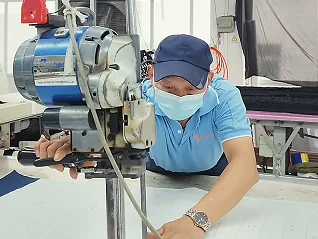
Relevant factory experience can improve the proposal, but a machine list does not prove execution quality or a price advantage. Review comparable samples, the proposed operation sequence and the checking points. Confirm the method available for your order rather than attributing equipment or capabilities to Shengfu without evidence.
Separate Setup from Recurring Cost
Development, pattern work, guides or process preparation may be spread across a run. Several small colour batches, material combinations or changeovers can create a different cost profile from one continuous run. Production planning therefore needs quantities by style, colour and size, not just an order total.
Ask which charges are separate, which are included in the unit price and which apply again on a repeat. Do not count a development charge twice. A larger run does not guarantee a saving if material availability, capacity or the schedule changes the proposal.
| Invented per-garment example, USD | Detailed style | Minimal style |
|---|---|---|
| Fabric and lining | 8.00 | 15.00 |
| Trims and decoration | 3.00 | 1.50 |
| Cutting, sewing and finishing | 9.00 | 7.00 |
| Allocated development and setup | 1.00 | 1.50 |
| Other included costs and margin | 4.00 | 4.00 |
| Illustrative total | 25.00 | 29.00 |
These invented figures illustrate arithmetic only. They are not a Shengfu quotation, industry benchmark or evidence about particular materials. The detailed style costs less here because its lower material spend offsets more assembly work. Change the assumptions and the order can reverse.
Compare Like-for-Like Quotes and Test Alternatives
In apparel sourcing, match the design, material references, construction, order breakdown, quality requirements and commercial scope before comparing prices. Identify packaging, testing, delivery basis, currency and exclusions. Quality control must address the same deliverable in both offers.
Intertek describes inspection across production stages. Ask which checks are included, when approval is required and how deviations are handled. A lower quote may reflect a suitable method, a different scope or an unresolved assumption; get an explanation before deciding.
Send Shengfu the tech pack or references, material requirements, quantities and target budget. Ask for the main cost drivers and separately costed alternatives that preserve your priorities. A useful clothing manufacturer should connect the proposed saving with its effect on the physical sample. Review fit, appearance and performance before releasing an alternative to clothing production.
FAQ
How to choose fabric for clothing without losing the intended product?
Compare identified options against drape, opacity, touch, stretch, care and consumption. Review a trial or complete sample before accepting a cost reduction.
What is a tech pack’s role in comparing complex and minimal styles?
It defines the material, construction and finish to be costed. Compare the same brief and order scope instead of asking suppliers to infer quality from a photograph.
How to choose a clothing manufacturer for a demanding detail?
Review relevant samples, the proposed production method and quality checks. Confirm who owns difficult operations and whether the method suits your material and quantity.
How to make clothing samples that test a cheaper method?
State the feature to preserve and the alternative to test. Compare the trial with the approved reference for appearance, comfort and performance; record its material and construction.
What is a pre production sample’s role after a cost change?
It confirms the proposed production garment at the agreed approval stage. A cost-driven change should appear in the controlled specification and sample record before release.
References and Further Reading
Technical and development sources:
- Coats Digital — GSDCost Method and Time Benchmarking
- Coats — Eliminating Seam Puckering
- Intertek — Textile and Apparel Inspection
- Techpacker — What Is a Tech Pack?
Related Shengfu guides:
- The Biggest Garment Cost May Not Be the Fabric
- Beyond the Unit Price: A Clothing Buyer’s Quotation Comparison Sheet
- What Is a Quote? How to Get a Clothing Manufacturing Quote
- From “We Can’t Make It” to a Workable Garment: A Development Plan
- French Seams, Bound Seams or Overlock? Spend Where It Matters
- Same Garment, Different Colour: Why Can the Cost Change?
- Why Does a Lower MOQ Mean a Higher Unit Price?
- From One Sample to 1,000 Garments: Consistency Is the Real Test





